How to Journal Through the Bible: A Practical Guide to Scripture Reflection
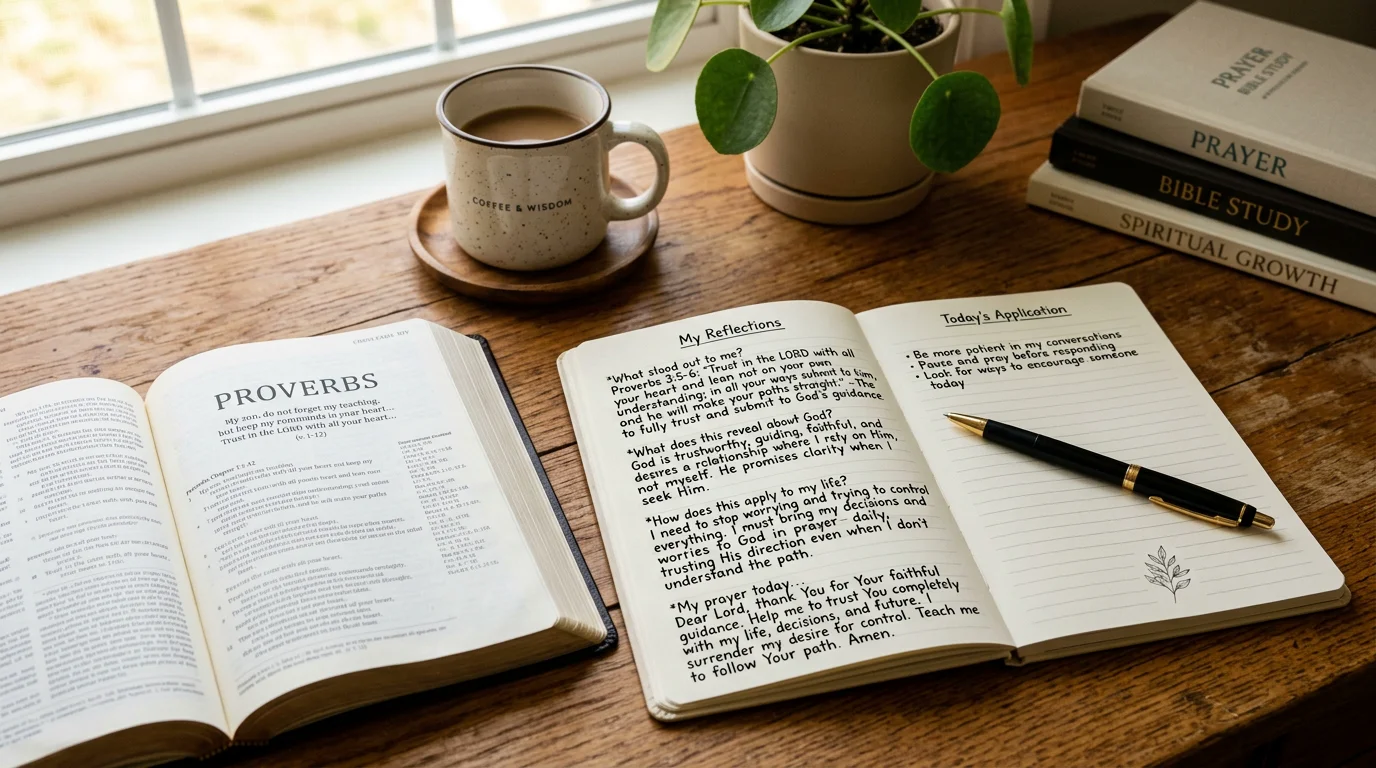
You don't need a beautifully illustrated notebook, a collection of coloured pens or an hour of uninterrupted quiet to start journaling through the Bible.
A Bible journal can be as simple as a notebook in which you slow down long enough to notice what Scripture says, think about what it means and consider how it should shape the way you live.
Some days you may fill a page. On others, you may write only a few lines. The value isn't in how much you write. It is in learning to read attentively and respond thoughtfully.
If you have never kept a Bible journal before, the blank page can feel surprisingly intimidating. What are you supposed to write? Are you simply copying verses? Should every reading produce a profound spiritual insight?
It doesn't need to be complicated.
This guide will show you a simple five-step approach:
Read → Notice → Reflect → Apply → Pray
The aim isn't to create a perfect journal. It is to create space for Scripture to be read carefully, considered honestly and carried into everyday life.
What Does It Mean to Journal Through the Bible?
Bible journaling can mean different things to different people. Some people decorate the margins of a journaling Bible with illustrations, lettering or colour. That can be a meaningful creative practice, but it isn't the only way to journal through Scripture.
For our purposes, Bible journaling means writing as you engage with the biblical text.
You might record:
- something you noticed in the passage;
- a question you want to explore;
- a repeated word or theme;
- something the passage reveals about God or human behaviour;
- an area of your life that the passage causes you to reconsider;
- a practical response;
- or a short prayer arising from what you have read.
Your journal doesn't replace the Bible. It helps you slow down and interact with what you are reading.
Why Keep a Bible Journal?
It is easy to read a chapter of the Bible and realise five minutes later that you remember very little of it.
Writing encourages you to pause.
A sentence that might have disappeared during a quick reading can become something you think about for the rest of the day simply because you stopped to put it into your own words.
Journaling can also create a useful record. Over time, you may notice recurring questions, areas in which you have changed your thinking, prayers you have repeatedly brought before God, or passages that have become particularly significant to you.
But a journal should never become another source of pressure.
You don't have to produce a page every morning. You don't have to journal every chapter. And missing several days doesn't mean you have failed.
The journal is a tool, not the goal.
What Do You Need to Start Bible Journaling?
Very little.
A Bible, something to write with and somewhere to record your thoughts are enough.
A simple notebook works perfectly well. You may prefer a dedicated Bible-study journal with prompts, or you might keep notes digitally on your phone, tablet or computer.
There is no spiritual advantage in owning expensive stationery.
Choose something you are likely to use consistently.
If a beautiful journal encourages you to sit down and read, use one. If a £2 notebook removes the pressure to make every page look perfect, use that instead.
The important question isn't:
“What kind of journal should I buy?”
It is:
“Will this help me engage more thoughtfully with Scripture?”
A Simple Five-Step Bible Journaling Method
When you're unsure what to write, use five simple movements:
READ → NOTICE → REFLECT → APPLY → PRAY
You don't need to answer every possible question about a passage. This framework simply gives your reading some direction.
1. Read
Begin with the biblical text itself.
Read a manageable section slowly. For some books, that might be a chapter. For others, a paragraph or shorter passage may be more appropriate.
If possible, read it twice.
The first reading helps you understand the general flow. During the second, pay attention to details you may have missed.
Resist the urge to begin writing your application before you have considered what the passage actually says.
Ask:
Who is speaking? What is happening? What is being taught, commanded, warned against, promised or described?
Context matters. A verse should not be separated from its surrounding passage simply because one sentence sounds personally meaningful.
2. Notice
Now record what caught your attention.
Perhaps a word is repeated. Perhaps two behaviours are contrasted. Maybe the passage contains a question, warning, command or unexpected response.
At this stage you aren't trying to produce an impressive interpretation.
You are simply noticing.
You might write:
“The writer repeats the importance of listening before speaking.”
Or:
“I noticed that the warning is about the consequences of pride, not simply how other people perceive a proud person.”
The act of putting an observation into your own words often reveals whether you have actually understood what you read.
3. Reflect
Reflection moves from observation towards understanding.
Ask questions such as:
Why does this stand out to me?
What does this passage reveal about God, people, wisdom, faith or character?
Is there something here that challenges an assumption I hold?
Does this expose a pattern I recognise in myself?
Reflection should be honest rather than impressive.
Suppose you read a passage about listening before answering. You might remember that during disagreements you are often preparing your response while the other person is still speaking.
That is worth writing down.
Not because every verse is secretly about your circumstances, but because Scripture can cause us to examine how we actually live.
4. Apply
Application asks a practical question:
What could I do differently because of what I have read?
Try to make the answer specific.
“I will become more patient” is admirable, but difficult to act upon.
Instead:
“If I receive a message today that irritates me, I will wait before replying.”
Or:
“During my next disagreement, I will let the other person finish before deciding what I want to say.”
Biblical application often happens in ordinary moments: how we speak to a spouse, respond to a colleague, handle money, make business decisions, treat difficult people, use social media or behave when nobody is watching.
A journal can help move a biblical principle from an idea you agree with to a decision you can practise.
5. Pray
Finally, turn what you have read into prayer.
Your prayer doesn't need to be long.
If you have been reading about patience, ask God for patience.
If the passage has exposed pride, acknowledge it honestly.
If you have encountered something you don't understand, you can pray for wisdom and continue studying.
You might simply write:
“Lord, help me listen carefully today and not allow irritation to control my words.”
Prayer gives you an opportunity to respond to Scripture rather than merely analyse it.
What Should You Actually Write in a Bible Journal?
If you're staring at an empty page, try answering one or two questions rather than all of them.
What did I notice?
What does this passage teach?
What surprised or challenged me?
Is there something I need to reconsider?
Is there something to practise, avoid or remember?
What question do I still have?
What could I do differently today?
What would I like to pray about?
There is no requirement to complete a worksheet every time you open your Bible.
Sometimes one thoughtful sentence is enough.
A Practical Bible Journaling Example
Imagine that during your reading you encounter biblical teaching about being careful with your words.
Earlier that week, someone at work criticised something you had done. You felt the criticism was unfair and immediately began composing a defensive email.
Instead of treating the passage as a general statement about how other people should speak, you allow it to challenge your own response.
Your journal might look something like this:
Read:
I read a passage warning about careless speech and encouraging restraint.
Notice:
Wisdom is shown not only in knowing what to say, but also in knowing when not to speak immediately.
Reflect:
When I feel criticised, my instinct is to defend myself quickly. Sometimes I respond before I have properly considered whether part of the criticism might be fair.
Apply:
If I receive a message today that makes me angry, I will not send my first response immediately. I will reread it after I have calmed down.
Pray:
Lord, give me wisdom over my words. Help me listen carefully, recognise when correction is justified and respond without unnecessary anger.
Nothing about that entry is complicated.
But the reading has travelled from the page into a real decision.
That is where Bible journaling becomes particularly valuable.
What If Nothing Stands Out?
This happens.
You may read a passage and feel that nothing particularly profound has occurred to you.
Don't manufacture an insight.
You can write what the passage plainly says.
You can record a question.
You can note something you don't understand.
You can summarise the passage in one sentence.
Or you can simply read without journaling that day.
Bible study doesn't become unsuccessful because you didn't discover something dramatic.
Sometimes understanding grows gradually. A passage that seems difficult or unremarkable today may become clearer as you learn more about its context or encounter related passages elsewhere in Scripture.
Common Bible Journaling Mistakes
Bible journaling is simple, but a few habits can make it less useful.
Writing Before Reading Carefully
It is tempting to see a familiar phrase and immediately start writing about what it means to you.
Pause first.
Read what surrounds it. Consider the author, audience and context where appropriate.
Personal reflection is valuable, but it should grow from the biblical text rather than replace it.
Making Every Passage About Yourself
The Bible contains history, poetry, prophecy, wisdom literature, letters, narrative and other forms of writing.
Not every passage is a direct personal instruction.
Sometimes the first task is simply to understand what happened, what was being communicated and why it mattered in its original setting.
Application can come after understanding.
Trying to Write Too Much
A Bible journal isn't an essay competition.
If you expect yourself to fill several pages every day, the practice can quickly become exhausting.
Five thoughtful lines may be more valuable than two pages written simply because you feel obligated to fill the space.
Copying Someone Else's Reflection
Commentaries, sermons and study guides can be extremely useful.
But give yourself an opportunity to observe the passage before immediately searching for somebody else's explanation.
Ask your own questions first.
Then use reliable study resources when you need help understanding context, language or interpretation.
Treating Every Statement as a Personal Guarantee
This is particularly important when reading wisdom literature such as Proverbs.
A proverb generally expresses wisdom about how life ordinarily works; it should not automatically be treated as an unconditional promise that a particular outcome must happen in every individual circumstance.
Paying attention to genre helps us read Scripture responsibly.
How Much Should You Write?
As much as helps you think clearly.
Some days your entry might contain:
One observation. One application. One prayer.
That is enough.
On another day, a passage may raise several questions and you might write a full page.
Don't measure the quality of your Bible study by word count.
Consistency can be valuable, but consistency does not mean producing the same amount every day.
Paper or Digital Bible Journal?
Both can work.
Writing by hand encourages some people to slow down and concentrate. A physical journal also removes notifications and other digital distractions.
A digital journal can be searchable, easy to organise and available across devices.
Neither approach is inherently better.
You could even combine them: use a notebook for daily reflection and digital notes for longer-term study topics.
Choose the method that helps you pay attention rather than the one that looks most impressive.
How to Build a Sustainable Bible Journaling Habit
Start smaller than you think you need to.
Instead of committing yourself to an hour every morning, begin with a manageable passage and ten or fifteen minutes.
Attach your reading to an existing part of your routine if that helps. Perhaps after breakfast, before starting work or during a quiet period in the evening.
Keep your Bible and journal somewhere easy to reach.
Most importantly, don't turn Bible journaling into a streak you are afraid to break.
You will miss days.
Life will interrupt your routine.
When that happens, simply continue.
You don't need to write three days' worth of journal entries to “catch up” before you're allowed to move forward.
The goal is engagement with Scripture, not maintaining a perfect record.
Where Should a Beginner Start?
You can journal through any biblical book, but choosing something manageable can make the habit easier to establish.
The Gospel of Mark, Philippians, James and selected Psalms can provide accessible starting points for different kinds of biblical writing.
Proverbs is particularly useful for practising short reflection and everyday application because it repeatedly addresses subjects such as speech, relationships, work, money, self-control, integrity and decision-making.
If you would like a structured starting point, our 31-Day Proverbs Reading Plan takes you through one chapter each day with a practical wisdom focus and reflection question.
You can also begin with Proverbs Bible Study for Beginners if you want guidance on approaching the book before starting the reading plan.
Frequently Asked Questions About Bible Journaling
The Bible does not command Christians to keep the kind of personal journal described in this guide. Journaling is simply a study and reflection tool. Practices such as meditating on Scripture, remembering God's words, prayer and thoughtful engagement with biblical teaching are found throughout Scripture, but keeping a notebook is a practical method rather than a biblical requirement.
Start Journaling Through Scripture
Bible journaling doesn't require artistic skill, expensive materials or pages of writing.
Start with Scripture.
Read carefully.
Notice what is actually there.
Reflect honestly.
Choose an appropriate response.
Then bring what you have discovered into prayer.
Over time, your journal can become more than a collection of notes. It can become a record of questions you have wrestled with, wisdom you have discovered, prayers you have offered and practical decisions you have made while learning to engage more thoughtfully with God's Word.
Ready to put the method into practice?
Start with the free 31-Day Proverbs Reading Plan and work through one chapter of Proverbs each day, with a practical wisdom focus and reflection question to guide you.
Continue Your Study of Biblical Wisdom
Put your journaling framework into daily practice with our free 31-Day Proverbs Reading Plan, featuring a chapter-by-chapter wisdom focus and thoughtful reflection questions for each day.
To explore additional study approaches and background, read How to Study the Book of Proverbs: A Practical 31-Day Guide to Biblical Wisdom or start with our beginner's guide, Proverbs Bible Study for Beginners.
For readers seeking a dedicated structured journal with daily Scripture readings, reflection prompts, application space and prayer guidance, Bible Proverbs Workbook for Daily Transformation provides a comprehensive 31-day companion.
Grow in Wisdom, One Study at a Time
Receive new Bible studies, reading plans and practical Christian resources as they are published.